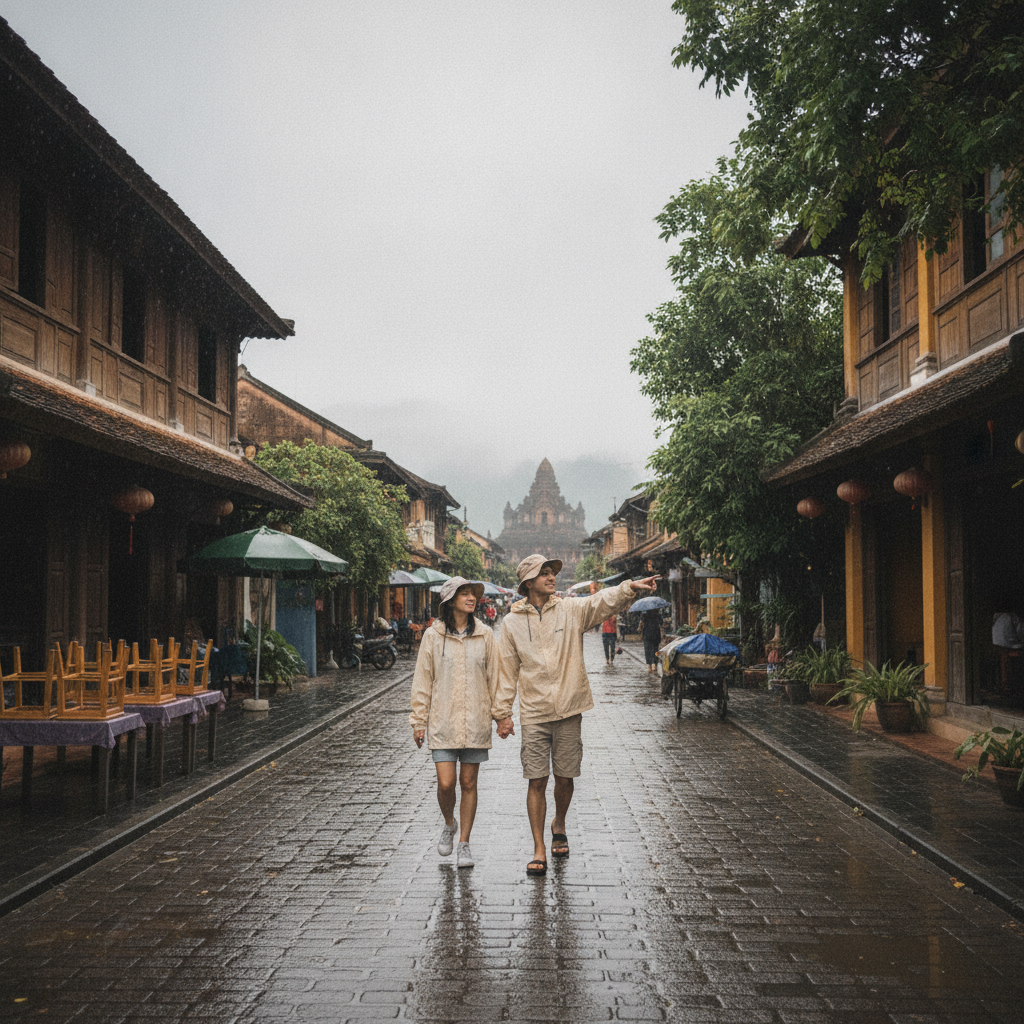
There is a particular kind of traveler who arrives at a famous temple complex in Southeast Asia and finds it almost entirely to themselves. The stone courtyards are slick with recent rain. A low mist hangs over the surrounding jungle canopy. The entrance fee is the same as it would be in the dry peak months, but the flight cost a fraction of what it would have been in January, and the guesthouse rate was negotiated down to something that felt almost implausible. This traveler did not stumble into luck. They planned around the shoulder rainy season — that narrow, misunderstood band of weeks when high season has just ended, the rains have begun in earnest, and most visitors have turned their attention elsewhere.
The shoulder rainy season is not the deep wet season. It occupies a transitional zone, typically the first four to six weeks after peak tourist months close, when rainfall increases meaningfully but has not yet reached its most intense and sustained period. In practical terms, this means mornings that are often clear, afternoons interrupted by heavy showers, and evenings that return to something soft and warm. For destinations like Luang Prabang in Laos, the Alentejo region of Portugal, or the hill towns surrounding Chiang Mai in northern Thailand, this rhythm shapes the daily experience in ways that are often more textured and authentic than anything the dry season delivers.
What the Pricing Shift Actually Looks Like
The financial difference between peak season and shoulder rainy season travel is rarely discussed with the specificity it deserves. Airlines adjust pricing dynamically, and routes to long-haul destinations — particularly those in Southeast Asia, Central America, and parts of East Africa — can reflect drops of thirty to forty percent off peak fares during these transitional weeks. Hotel and guesthouse rates follow a similar pattern, but the shift is often more dramatic because occupancy drops sharply the moment school holiday periods end in major source markets. Properties that hold firm on pricing during peak months become suddenly negotiable. It is not uncommon to book a well-regarded boutique property through platforms like Booking.com or direct email at a rate that would have been refused entirely two months earlier. When these reductions compound — cheaper flights, cheaper accommodation, cheaper day tours due to lower demand — the total trip cost reshapes itself substantially.
Food costs also behave differently during this period. In destinations where a strong tourist economy drives restaurant pricing upward during peak months, the shoulder rainy season often sees more honest pricing return to menus, especially in locally oriented areas where fewer international visitors are present. Markets are fuller with seasonal produce, and the dishes tied to that produce — what the Vietnamese call *cơm niêu* or clay-pot rice, or the tamarind-heavy broths of northern Laos that appear primarily in monsoon months — reflect ingredients at their most abundant and least expensive. The experience of eating shifts from tourist-facing performance toward something more genuinely regional.
The Experience Side of the Equation
Beyond cost, the shoulder rainy season changes what a destination actually feels like to move through. The crowds that define peak season at places like Angkor Wat in Cambodia or the temples of Kyoto's Arashiyama district thin to a fraction of their usual presence. Staff at museums, heritage sites, and small restaurants have more time for conversation. The transaction becomes less frictionless and more human. Guides who spend their dry-season months rotating through group after group of forty people will often offer something more considered and personal during this quieter period, either in a smaller group format or through rate structures that suddenly allow for private or semi-private arrangements.
Rain itself deserves a more nuanced assessment than most travelers grant it. A heavy afternoon shower in the tropics rarely lasts more than ninety minutes. What it leaves behind — cleaned air, cooler temperatures, the smell of wet stone and vegetation — often produces the most atmospheric moments of a trip. Photographers who understand this tend to plan around shoulder rainy season deliberately, knowing that the light after a storm, particularly in landscapes with rivers, rice paddies, or ancient ruins, is unlike anything the flat midday sun of dry season produces. The Vietnamese concept of *tiểu mãn* — a solar term marking the beginning of the rainy transition and associated with fullness and harvest — captures something of this richness that pure tourism calendars rarely acknowledge.
What Requires More Preparation
The tradeoffs are real, and honest planning accounts for them. Some outdoor activities that define a destination's peak-season appeal may be partially unavailable — certain trekking routes become muddy or closed, river conditions change, and some small regional tour operators scale back their schedules during the shoulder period. Travel insurance becomes more important, not because rainfall is dangerous in itself, but because itinerary flexibility matters more when a day's plans can shift without warning. Policies that include trip interruption and activity cancellation coverage, available through providers like World Nomads or Allianz Travel, are worth the added cost in this context rather than an afterthought.
Packing also changes. The standard advice around light fabrics and minimal luggage still applies, but waterproof layers, a compact umbrella, and dry bags for electronics are functional requirements rather than optional additions. The traveler who arrives at the shoulder rainy season underprepared for actual rain often spends more correcting the oversight locally than they saved on the airfare.
What You Gain That Has No Price
For anyone who has stood in the middle of a famous square or heritage site during peak season and felt, despite all the beauty around them, a vague sense of distance from the place itself — as though the destination has become a set rather than somewhere people actually live — the shoulder rainy season offers something genuinely different. The rhythms that locals follow become more visible. The morning markets are for the neighborhood, not the tour bus. The guesthouses are quieter. The streets belong to everyone equally. This is the quality that seasoned travelers describe when they talk about a destination *before it changed*, though what they really mean is that they encountered it in a mode that felt less mediated by the machinery of peak-season tourism.
That early scene — the traveler alone in the wet courtyard, the mist over the jungle, the improbable room rate — is not an accident of fortune. It is the direct result of a decision to book during a window that most itineraries skip without thinking. The budget changes more than expected. So does the experience. And the two turn out to be more connected than they first appear.