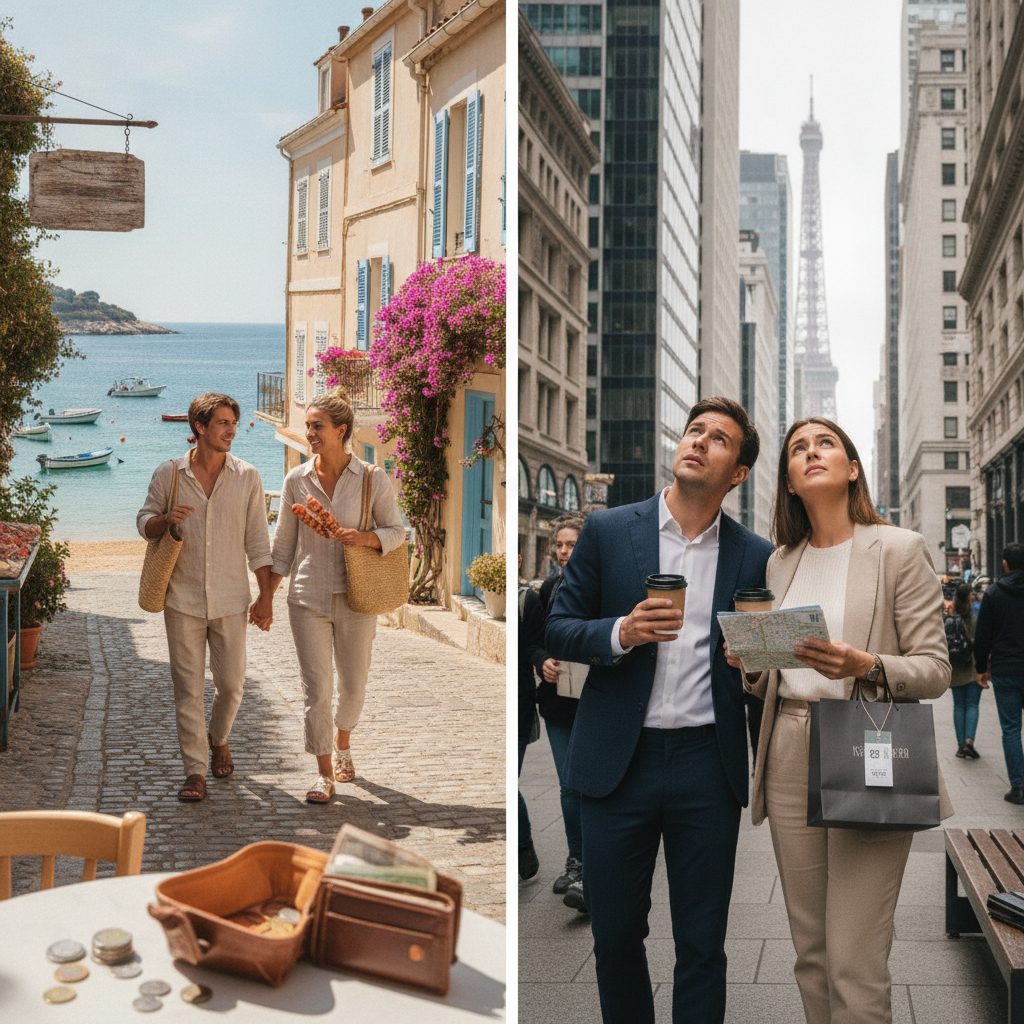
The decision of where to sleep determines far more than a traveler usually expects. Choose a capital city as a base — Rome, Lisbon, Athens — and a particular rhythm takes hold almost immediately: dense crowds, elevated menu prices, a visual field dominated by grand monuments and tourist infrastructure. Choose instead a smaller coastal town an hour or two beyond that capital, and something quieter but equally rich asserts itself. The food changes, the pace changes, and so does the money leaving the wallet each day. This is not simply a matter of preference. It's a structural shift in how a trip is experienced, financially and culturally, from the first morning coffee to the last evening meal.
The Real Arithmetic of Where You Base Yourself
Capital cities carry premium pricing almost by default. Hotels cluster near famous landmarks, restaurants near those hotels price aggressively, and the entire ecosystem reflects the assumption that visitors are transient and willing to pay for convenience. A meal in central Athens or central Lisbon at a table facing a famous square costs measurably more than the same ingredients prepared with equal skill in a fishing town thirty kilometers away. The gap isn't always dramatic in isolation — a few euros per dish, perhaps — but across a week, across three meals a day and a daily coffee ritual, that arithmetic accumulates into a meaningful difference. Travelers who base themselves in coastal towns like Nafplio in Greece or Setúbal in Portugal consistently find that daily food expenditure drops without any sacrifice in quality, and often with a noticeable gain in authenticity.
Accommodation follows the same logic. Coastal towns outside major tourist circuits tend to offer family-run guesthouses, *pensões* (the Portuguese term for small family-operated inns), and smaller boutique stays at rates that capital-city hotels rarely match. The rooms may be smaller, the lobbies less grand, but the experience of waking up to a view of the harbor rather than a busy urban intersection carries its own reward that no star rating captures. Booking platforms like Booking.com and Airbnb both reveal this price gap clearly when travelers compare similar property types across a capital and a nearby coastal alternative — the difference is rarely marginal.
What the Coastal Base Actually Changes About Sight-Seeing
There is a certain tyranny to capital-city tourism that most travelers recognize only in retrospect. The famous sites are genuinely worth seeing — the Acropolis, the Alfama district, the Vatican — but the experience of seeing them from a capital base means arriving already tired from urban noise, having spent money on transport within the city, and competing with the densest concentrations of other visitors. The coastal town base inverts this dynamic. Day trips into the capital become events rather than defaults. Travelers choose their capital-city days deliberately, arrive with energy, and return to somewhere quieter in the evening. The sense of contrast makes both places feel more vivid.
Coastal towns also offer their own cultural texture that capital-intensive itineraries tend to miss entirely. The morning fish market in a small Aegean port, the way locals gather at a particular café in a Sicilian town between ten and noon, the Sunday rhythm of an Algarve village — these are the observations that form the deeper memory of a trip. *Passeggiata*, the Italian evening stroll that brings an entire town's population into the same streets at the same unhurried hour, is experienced most genuinely in smaller coastal places where it hasn't been absorbed into tourist spectacle. These cultural rhythms cost nothing to witness and nothing to participate in, but they require proximity — the kind that only comes from sleeping there rather than passing through.
Transport Costs and the Logic of Staying Just Outside
One objection to the coastal base strategy is transport: if the capital's museums, monuments, and restaurants are the primary draw, doesn't the cost of traveling back and forth erase the savings made on accommodation and food? In most Mediterranean and European contexts, the answer is no, but the calculation requires honesty. Train connections between coastal towns and their nearest capitals are often efficient and inexpensive. The journey from Setúbal to Lisbon by train takes under an hour and costs a fraction of a single night's accommodation saved by staying outside the city. The same logic applies to connections between Nafplio and Athens, or between Trapani and Palermo in Sicily. The key variable is frequency — some coastal towns have limited evening services, which shapes how late a traveler can stay in the capital without incurring taxi costs or overnight inconvenience.
For travelers willing to rent a vehicle, the coastal base becomes even more flexible. A car unlocks not just the capital but the surrounding countryside, smaller villages, and coastline that public transport networks rarely serve well. The cost of a rental split across several days often compares favorably to what would have been spent on urban taxis and day-trip tours booked from a city hotel. The freedom to stop at a roadside produce stand, to detour toward a quiet beach at the end of an afternoon, or to find an unassuming trattoria in a hill town — these experiences are the quiet dividend of the coastal base strategy.
What You Actually Gain by Slowing the Frame
Travel rarely rewards speed, but capital cities tend to encourage it. The sheer density of things to see creates a low-level urgency that pushes visitors from sight to sight with little time to simply exist in a place. The coastal town base naturally counteracts this. When the town itself offers a harbor promenade, a local market, and a handful of genuinely good restaurants at reasonable prices, there is less compulsion to fill every hour with planned activities. An afternoon spent watching boats return from a morning catch, or sitting at a café table while the light changes over the water, begins to feel like the trip rather than dead time between the real attractions.
This shift in pace is not merely pleasurable — it tends to reduce spending. Boredom and urban stimulation are among the most reliable drivers of impulsive tourist expenditure: overpriced museum gift shops, unnecessary guided tours, restaurant choices made out of exhaustion rather than appetite. The coastal base removes many of these triggers by replacing them with a different kind of abundance. You begin to understand why the locals chose to live there, which is perhaps the most useful thing a traveler can learn anywhere.
The traveler who opens a trip by asking where to sleep is, without knowing it, asking a much larger question — one that will shape every meal, every bill, and every afternoon that follows. The coastal town answers that question differently than the capital does, and for those willing to accept a slightly longer route to the famous monuments, the reward is a version of the destination that most visitors never quite reach.