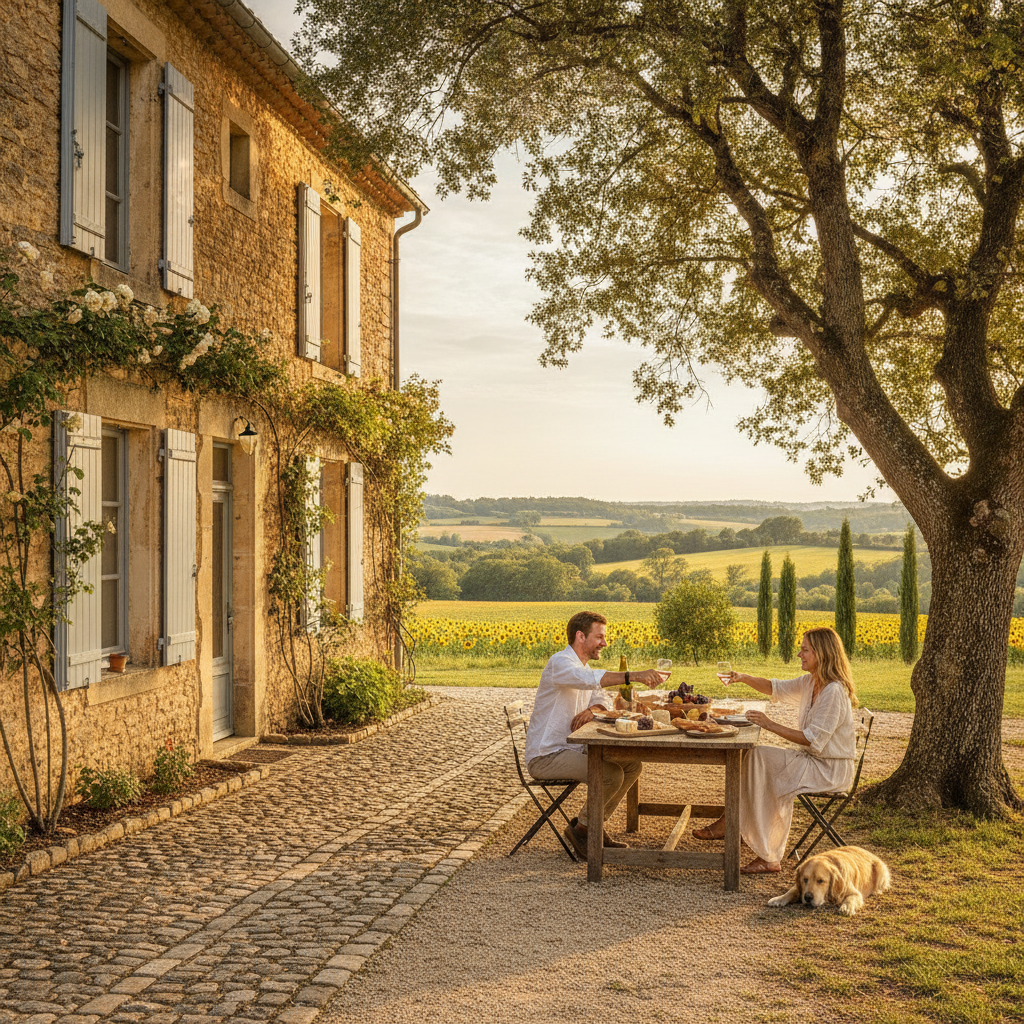
Travel has a way of revealing the gap between what people think they want and what actually stays with them long after they return home. The fantasy of Paris — the grand boulevards, the hotel with the gilded elevator, the breakfast buffet arranged like a museum installation — is a powerful one, and the tourism industry has spent decades perfecting it. But somewhere between the third overpriced café crème near the Marais and the fourth night in a room that costs twice what it should, a quieter possibility starts to suggest itself: that the version of France most travelers never find is the one that costs considerably less and gives considerably more.
The Economics of Staying Outside the City
A converted farmhouse — or *gîte*, as it's known in France — operates on a fundamentally different pricing model than urban accommodation. A *gîte* is a self-catering rental property, often a restored agricultural building in the countryside, rented by the week and designed for independent living rather than hotel-style service. The weekly rate for a stone farmhouse in the Dordogne or the Lot valley is frequently comparable to three or four nights at a modest Paris hotel, and that price includes a full kitchen, multiple bedrooms, outdoor space, and often a private garden or terrace. When the per-night cost is spread across a full week and divided by a travel party of even two people, the arithmetic shifts dramatically. The traveler who books through platforms like Gîtes de France or Airbnb and chooses a rural property over a city-center room is making a choice that compounds its savings across every meal prepared at home, every bottle of wine bought from a local cave rather than a restaurant wine list.
This arithmetic is only part of what the experience teaches. The deeper lesson is about what a travel budget is actually buying — not nights and square footage, but access to a place, its rhythms, its textures, and the kind of time that allows genuine attention.
What the Slower Pace Actually Changes
In Paris, the implicit pressure is always to move. The city's density of famous things creates an itinerary gravity that pulls travelers from arrondissement to arrondissement, from landmark to landmark, spending as they go. Museums charge entry fees, famous restaurants charge for the address as much as the food, and transportation across the city adds up quietly. Rural France inverts this logic entirely. The village market in a town like Sarlat-la-Canéda or Saint-Antonin-Noble-Val runs on Wednesday and Saturday mornings, and the weekly rhythm of local commerce structures the days without demanding anything additional. A morning at a *marché* — a farmers' market — costs nothing to attend and very little to enjoy well. The traveler who spends an hour selecting cheese from a *fromager*, bread from a *boulanger*, and a few seasonal vegetables from a small producer is not simply saving money on lunch. They are encountering a version of French daily life that the hotel-based tourist in Paris rarely touches.
That encounter has a quality that cannot be priced on a comparison website. It generates the kind of memory that travel is ostensibly for — the specific, sensory, irreproducible kind — and it does so at a fraction of the cost of a set-price dinner in a well-reviewed bistro.
Understanding Value Beyond the Nightly Rate
Real trip value is not a single number. It is the ratio between what a trip costs and what it actually delivers — in experience, in rest, in exposure to something genuinely different, in the quality of time spent. By this measure, the farmhouse in rural France routinely outperforms the Parisian hotel even when the base cost appears similar, because the surrounding cost structure is so different. Groceries bought at a local market in the Périgord region are dramatically cheaper than anything served in a Parisian restaurant. A bottle of Bergerac wine purchased directly from a domaine costs a fraction of the same bottle on a restaurant wine list. A bicycle rental for a week of exploring the Vézère valley costs less than a single Michelin-starred lunch.
The traveler who understands this is not cutting corners. They are redirecting money from infrastructure costs — the room service, the concierge, the central location premium — toward actual experience. The *gîte* model essentially funds itself differently: it shifts spending away from the intermediary (the hotel) and toward the place itself.
The Cultural Education That Comes With the Territory
Staying in rural France is not simply a budget strategy. It is a form of cultural education that urban tourism rarely provides. The rhythms of the French countryside — the two-hour *déjeuner*, the near-total commercial shutdown on Sunday afternoons, the importance of the *apéritif* hour as a social ritual rather than a prelude to drinking — become lived experience rather than observed behavior. The traveler adjusts to these rhythms or finds themselves inconvenienced, and in that adjustment something shifts. France stops being a backdrop and starts being a place with its own internal logic, one that rewards patience and penalizes the same hurried efficiency that makes city tourism so exhausting.
The *déjeuner*, for instance, is not a quaint local custom — it is the main meal of the French day, and understanding this changes how a traveler spends both time and money. A two-course lunch at a rural *restaurant gastronomique* before 2 p.m. frequently costs half what dinner would, and is taken more seriously by the kitchen. This is the kind of knowledge that a week in the countryside transfers naturally, simply through the experience of living inside it.
What You Discover About Yourself as a Traveler
Perhaps the most durable lesson of the farmhouse over the hotel is a personal one. The traveler who chooses the *gîte* in the Lot valley is implicitly choosing a different relationship with a place — one that trades stimulation density for depth, and convenience for authenticity. That choice reveals something about what travel is actually for. If the goal is the landmark photograph and the restaurant reservation, Paris delivers. If the goal is to feel, however temporarily, like someone who lives differently and sees the world differently, the farmhouse offers something the hotel cannot. It offers time — unstructured, unprogrammed, genuinely available time — and that turns out to be the rarest and most valuable thing a trip can provide.
The person who returns from a week in a stone farmhouse in the Corrèze, having visited no famous museums, attended no ticketed events, and eaten almost every meal at a table they set themselves, often comes back more rested and more changed than the person who saw everything Paris had to offer. The distance between those two trips, in cost and in value, is worth understanding before the next booking begins.