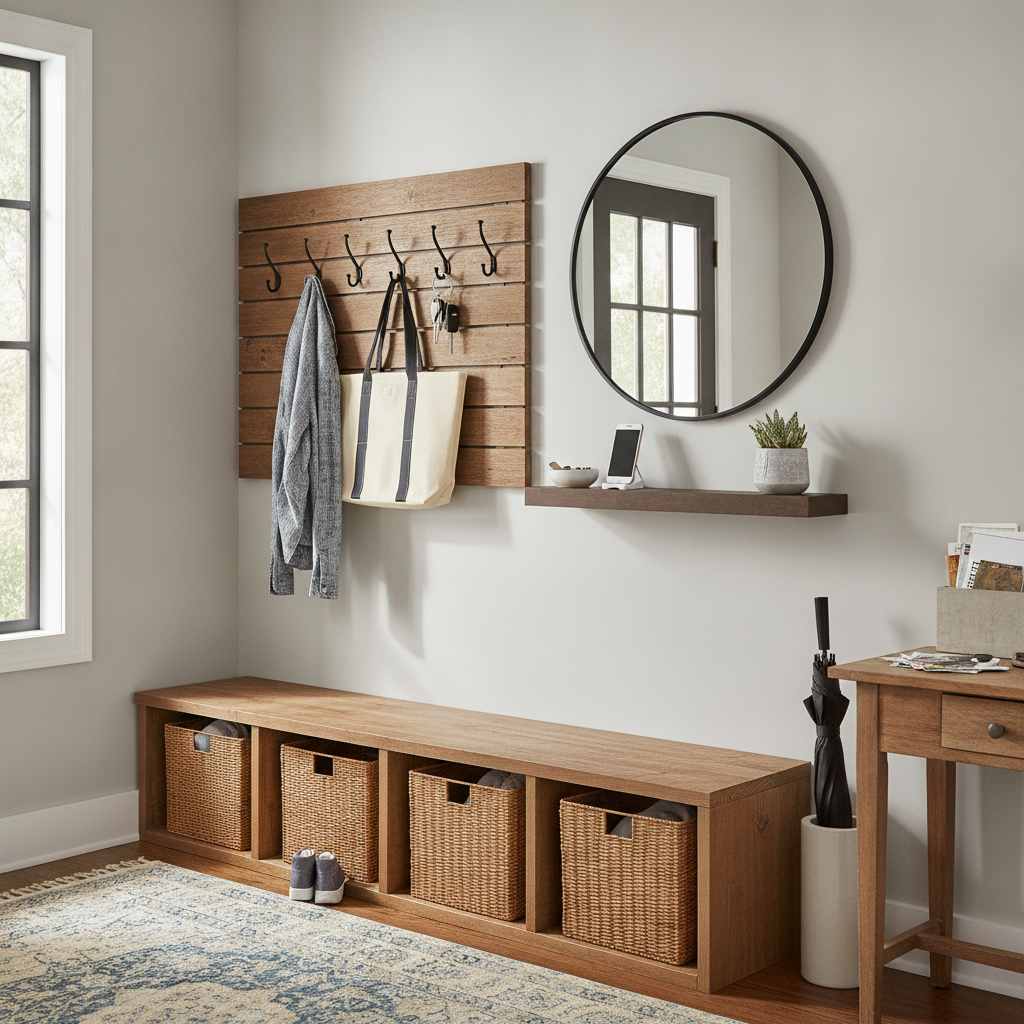
Every household has a version of the same problem: keys land on the kitchen counter, bags slump against the wall, mail spreads across whatever surface is closest, and shoes form a loose pile that nobody quite owns. The front door area becomes a daily collision point between your outside life and your home, and without a clear system, it defaults to chaos. A well-designed drop zone changes that — not by adding complexity, but by giving each item a logical home the moment you walk through the door.
Choose a Spot You'll Actually Walk Past
The best drop zone is the one that intercepts you naturally, not the one that requires a detour. If your entry hall is narrow, a wall-mounted solution from IKEA or Pottery Barn keeps the floor clear while still giving you hooks, a small shelf, and maybe a slim cabinet. If you have more room, a compact console table with a few bins underneath can do the same job. The point is proximity — your system needs to be physically in your path, not tucked away in a corner you have to choose to walk to.
Give Keys a Single, Unmovable Home
Keys are the item most likely to derail your morning if they go missing, and the fix is almost embarrassingly simple: one hook, always in the same place, used every single time. Wall-mounted key hooks are inexpensive and widely available — brands like Umbra make versions that mount cleanly without looking utilitarian. The habit forms faster than you'd expect when the hook is at eye level and within arm's reach of the door. If multiple people share the space, assign a hook per person rather than a shared hook that inevitably gets ignored.
Add a Mail Slot or Tray That Has a Clearing Rule
Mail is one of the slowest-moving clutter problems in any home because it feels too important to throw away immediately but not urgent enough to deal with right now. A small wall-mounted mail organizer or a shallow tray on the console table gives it a landing spot, but the organizer alone won't help unless you pair it with a simple rule — nothing stays in the tray longer than three days. After that, it either moves to where you handle finances or gets recycled. The container manages the mess; the rule prevents it from becoming permanent.
Use Hooks Generously and Label Them If Needed
A row of hooks near the door does more work per square inch than almost any other organizational tool. Bags, jackets, scarves, dog leashes, umbrellas — all of it has somewhere to go instead of pooling on the floor or a chair. In households with kids, labeling hooks by name (a simple strip of washi tape works fine) removes the ambiguity about whose stuff goes where. Sturdier options from companies like Command or Rejuvenation can hold more weight and look intentional rather than improvised.
Create a Shoe Solution That Matches Your Habit
The most effective shoe storage isn't necessarily the most attractive — it's the one that matches how people actually remove shoes in your home. If everyone kicks shoes off while still moving, a low bench with an open shelf underneath from a retailer like Target or Wayfair works better than a lidded cabinet that requires stopping to open. If the entry is tight, a slim stackable rack tucked along one wall keeps things off the floor without blocking traffic. Two or three pairs per person is a reasonable cap; the rest belong in a bedroom closet.
Keep a Small Basket for the Stuff That Belongs Elsewhere
Every drop zone collects a little bit of everything — a library book that needs returning, sunglasses borrowed from another room, a grocery list someone left out. Rather than letting these items scatter across your entry shelf, a small basket or bin corrals them in one place. The basket isn't permanent storage; it's a transit zone. Once a week, whoever passes by grabs the basket and redistributes its contents to where they actually belong. It takes two minutes and prevents the slow creep of random objects taking up permanent residence at the door.
Make It Look Like a Choice, Not an Afterthought
Drop zones that feel intentional are far more likely to be respected and used consistently. A small framed print above the hooks, a plant on the shelf, or a ceramic dish for pocket change signals that this area was designed — which makes people treat it more carefully. Anthropologie and West Elm both carry entry-specific accessories that blend function with style without requiring a large investment. When the space looks good, there's a natural motivation to keep it that way rather than pile things wherever they fit.
Review and Reset the Zone Monthly
Even a well-designed drop zone drifts over time. Seasonal items accumulate — a winter coat that should now be in storage, an umbrella that belongs in the car — and the system slowly stops working as intended. A quick monthly reset, even just ten minutes of clearing, sorting, and returning stray items to their proper homes, keeps the zone functional without requiring constant attention. Think of it less as cleaning and more as routine calibration, the same way you'd check the batteries in a smoke detector. Small adjustments made regularly prevent the bigger problem of a system that quietly stops working.
Building a drop zone that genuinely works is less about finding the perfect product and more about designing a system that fits how your household actually moves. Start with one piece — a hook, a tray, a small bench — and build from there. The habits follow the structure, and before long, the chaos at the front door becomes the most organized spot in the house.