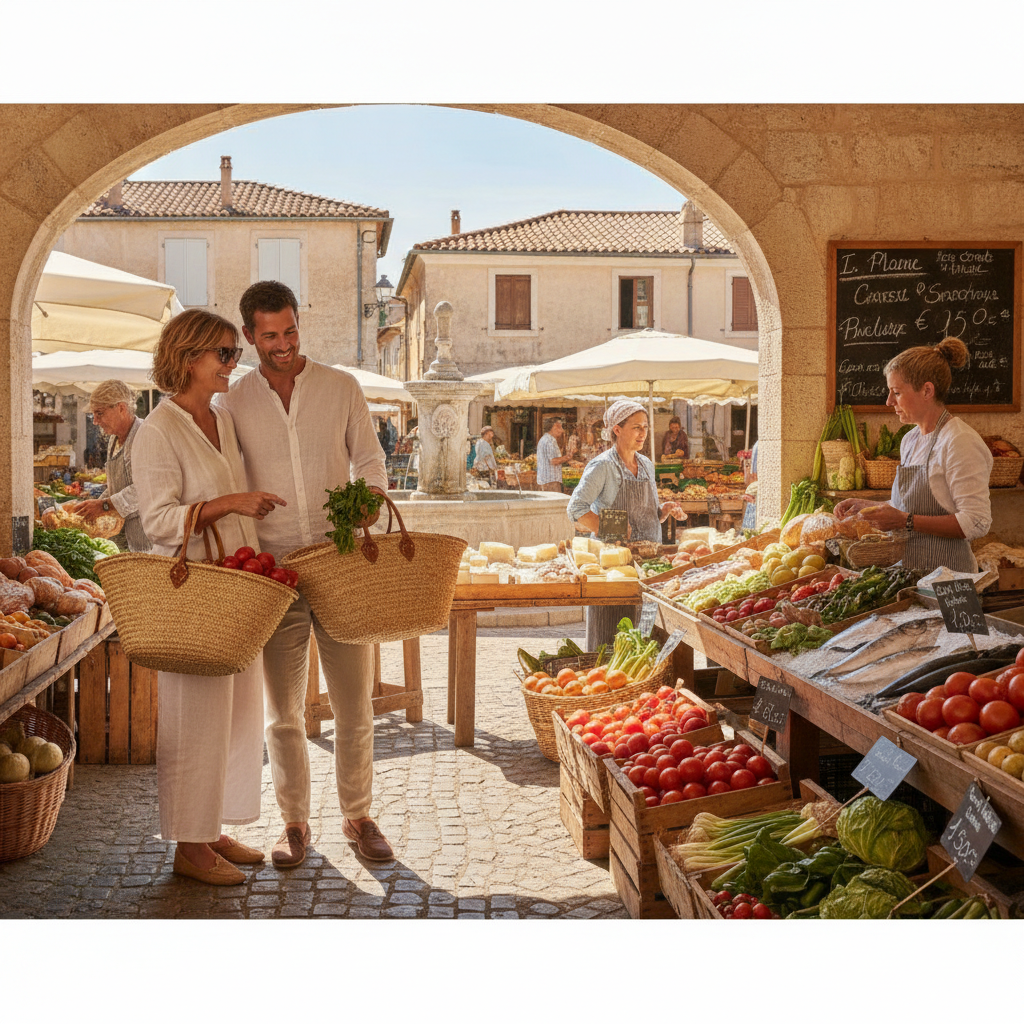
Eating well while traveling is one of those pleasures that can quietly become one of the most significant drains on a travel budget. Restaurants near popular landmarks charge what the foot traffic will bear, and the romantic idea of discovering a hidden local gem often ends with a meal that cost twice what it should have. The traveler who learns to read a city through its market calendar, however, tends to eat better, spend less, and leave with a far richer sense of place.
Find the Market Calendar Before You Pack
Most cities and towns with a strong food culture publish weekly or monthly market schedules online, often through the local tourism board or municipal website. In Provence, the open-air marchés rotate across villages on assigned days — Aix-en-Provence fills its cours Mirabeau on Tuesday, Thursday, and Saturday, while smaller surrounding towns each claim their own morning. In Oaxaca, the Mercado de Tlacolula draws vendors and buyers from across the valley every Sunday. Knowing these rhythms before arriving means a traveler can structure an itinerary around market mornings rather than retrofitting them into an already overbooked schedule. A quick search combining the destination name with the terms "mercado," "mercato," or "bazar" alongside the local word for "weekly" will surface what most guidebooks bury in footnotes.
Understand What Each Market Actually Sells
Not every market is a food market, and confusing a craft bazaar with a produce mercado leads to disappointment on both ends. The distinction matters because the cost savings available at a wet market — the term used across much of Southeast Asia for fresh produce and protein stalls — are categorically different from what's available at a curated artisan fair. In Chiang Mai, the Saturday Walking Street along Wualai Road is a handicraft market; the daily Warorot Market nearby is where locals actually shop for ingredients. Travelers who identify the latter type of market gain access to the same produce, pickled goods, spices, and prepared foods that local households depend on, often at prices that bear no relationship to what the nearest tourist café charges for a bowl made from the same ingredients.
How to Shop a Market Like a Regular
Arriving at a market with a plan makes a meaningful difference to what you spend and what you experience. Experienced market-goers tend to walk the full circuit once before purchasing anything — this allows for price comparison between vendors and helps identify who is selling to locals versus who has positioned a stall at the entrance specifically to intercept tourists. At Istanbul's Kadıköy Market on the Asian side, the difference in price between entrance stalls and those a few rows deeper can be notable for the same olives or dried fruit. Buying in the middle of the market's active hours — not at the very end, when prices may drop but selection is depleted — tends to yield the best combination of value and quality. Carrying a reusable bag signals familiarity with the format and often prompts a warmer interaction with vendors.
Turn Market Finds Into Meals Without a Kitchen
One of the persistent myths about market shopping is that it only benefits travelers with access to a self-catering apartment or rental with cooking facilities. In reality, many of the world's most satisfying market meals require no cooking at all. A round of aged cheese, a wedge of rough bread, cured meats, a handful of olives, and ripe seasonal fruit assembled on a park bench constitutes a genuinely regional meal in dozens of European destinations — and costs a fraction of a sit-down lunch nearby. In Vietnam and Thailand, the prepared food sections of local wet markets offer cooked dishes for less than the equivalent of a few dollars, made fresh and consumed at communal tables alongside market workers. The Spanish concept of the mercado-bar — a small counter operation embedded inside a food market, like those found in Barcelona's Mercat de Sant Antoni — offers cooked food at honest prices in an environment that is indisputably local.
Match Your Itinerary to the Market Week
For travelers spending more than a few days in one place, aligning daily plans with the local market schedule is one of the most effective budgeting tools available. A market morning in many cultures begins early and winds down before noon, which naturally shapes the rest of the day. Spending a morning at the market, assembling a light picnic lunch from fresh purchases, and reserving restaurant meals for evenings — when the social culture of dining out is most authentic — produces a daily food budget that is significantly lower than eating three restaurant meals per day. Over a week-long stay, this approach can shift enough of the food budget to fund an experience — a day trip, a cultural tour, a better room upgrade — that wouldn't otherwise have been affordable.
What to Watch For as Markets Evolve
As more travelers discover the value of market visits, the character of those markets is changing in some destinations. Gentrification and the arrival of food-tourism culture have transformed certain formerly workaday markets into curated experiences with pricing to match — a pattern visible in parts of London's Borough Market and, increasingly, in some Latin American capitals. The practical response is to look one step further than the famous market and find the neighborhood equivalent that serves the same function without the premium. Local Facebook groups, expat forums on Reddit, and city-specific travel apps like Spotted by Locals remain reliable sources for identifying markets that haven't yet been optimized for the tourism economy. The weekly market as a budget tool works best when treated as a living part of the destination rather than a destination itself — one that rewards curiosity, patience, and the willingness to eat something unfamiliar at a folding table with no English menu in sight.