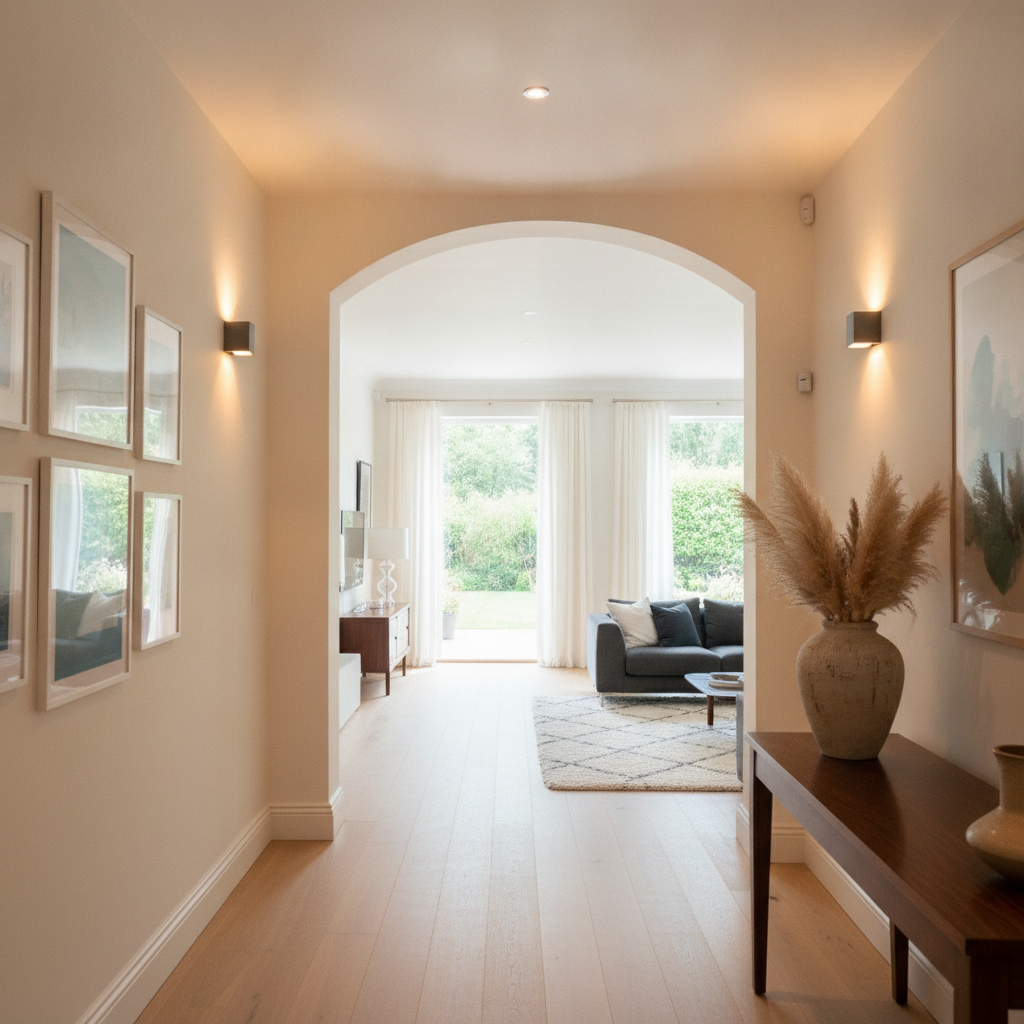
Most people decorate their hallways last, treating them as transitional spaces rather than rooms that deserve real attention. Yet the lighting in an entryway or corridor does something quietly powerful — it sets the emotional tone for the entire home. Before a visitor or resident ever reaches the living room, kitchen, or bedroom, their eyes have already adjusted, their mood has already shifted, and their perception of the next room has already been influenced by what they passed through to get there.
The Science of Visual Adaptation and First Impressions
When someone moves from a dim hallway into a brightly lit kitchen, the contrast feels jarring — almost clinical. The reverse creates a different problem: a brilliantly lit entryway makes the warmly lit sitting room beyond it feel gloomy by comparison. The human eye adapts continuously to ambient light, and those adaptation shifts happen faster than most people realize. Designers at firms like Lutron and Philips Hue have long understood this principle, building product lines specifically around the idea that light transitions between spaces shape how those spaces feel on arrival.
Why Hallway Lighting Is a Calibration Tool, Not Just Decoration
Thinking of hallway lighting purely as decoration misses its primary function: calibration. A well-considered hallway light level acts as a middle ground between the outside world and the interior atmosphere of the home. In neighborhoods like Brooklyn Heights or Notting Hill, where older townhouses often feature long, narrow corridors, designers frequently layer lighting — combining overhead fixtures with wall sconces — to create a gradual brightness transition rather than an abrupt shift. This layering prevents the eye from being overwhelmed or underwhelmed when moving deeper into the home.
Color Temperature Choices and Their Downstream Effect
Beyond brightness, color temperature plays an equally significant role. A hallway lit with cool, blue-toned bulbs (typically above 4000K) tends to prime the senses for alertness and efficiency — which can make a warm, amber-lit bedroom feel disconnected and oddly jarring in contrast. Warmer bulbs in the 2700K to 3000K range create a softer handoff, allowing living spaces to feel like a natural continuation rather than a separate environment. Brands like GE Cync and LIFX offer tunable white options that let homeowners experiment with temperature settings without committing to a single fixture.
How Ceiling Height and Hallway Width Change the Equation
The physical dimensions of a hallway interact directly with the lighting choices made within it. Low ceilings amplify the psychological weight of overhead fixtures, making recessed lighting a better choice than a single pendant that visually compresses the space. Narrow hallways benefit from fixtures positioned to throw light sideways onto walls rather than straight down, which creates the perception of width. When the hallway feels spacious and well-lit without being harsh, the rooms it connects tend to feel more cohesive — as though the whole home has been thought through rather than assembled room by room.
The Mistake Most Homeowners Make With Dimmer Switches
Installing dimmer switches in a hallway is one of the most practical upgrades available, but many homeowners set them once and forget them. Hallway lighting ideally shifts with the time of day — brighter during morning movement, softer in the evening hours before the household winds down. When the hallway remains at full brightness late at night, it creates a visual shock upon entering darker, more relaxed rooms. Smart dimmer systems, including those from Leviton and Caseta by Lutron, can be programmed to shift automatically, removing the need for manual adjustment and quietly improving the feel of every room that follows.
Practical Steps You Can Take Without Major Renovation
You don't need to rewire your home to make meaningful improvements. Start by swapping existing bulbs for warm-white options in the 2700K to 3000K range if your hallway currently uses cool or neutral light. Consider adding a simple plug-in wall sconce to break up flat overhead light and add visual depth. If you already have a dimmer, spend one week experimenting with lower settings in the evening and observe how the adjacent rooms feel by comparison — the difference is usually immediate. For longer hallways, a runner with reflective or light tones can amplify existing light without adding a single fixture. Small, deliberate changes compound quickly in a space that every household member passes through multiple times a day.
The hallway will always be the home's most underestimated room — but that doesn't mean it should be an afterthought. As smart home technology continues to make adaptive lighting more accessible and affordable, the connection between transitional spaces and overall home atmosphere is becoming easier for everyday homeowners to manage. The hallway that once felt purely functional is increasingly recognized as the room that quietly shapes how every other room in the home is experienced.