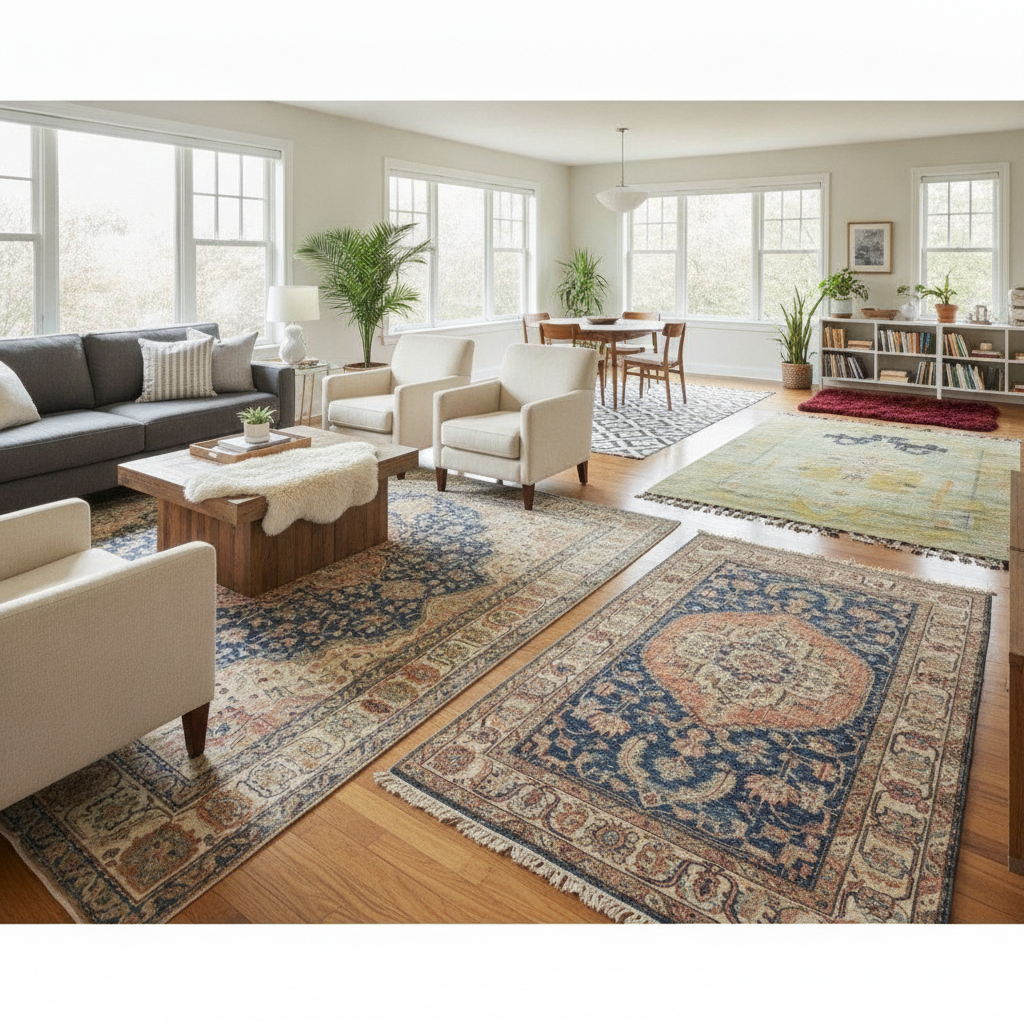
Open-plan living spaces are genuinely freeing — until you realize that without walls, a large room can feel like one formless, undefined stretch of floor. The seating floats. The reading corner bleeds into the TV area. Nothing quite feels like it belongs anywhere. Layering rugs is one of the most effective tools for solving this problem, and it doesn't require a contractor, a permit, or even a weekend of heavy lifting.
Start With the Largest Zone First
Before placing anything, identify the main anchor in the room — usually the conversation area around a sofa. This is where your first and largest rug goes. A common mistake is choosing a rug that's too small, which makes furniture look unmoored. The general rule is that at least the front legs of every major sofa and chair should sit on the rug. Brands like Ruggable and IKEA both offer large-format options that work well as base layers, with the added benefit of being washable or easy to swap out seasonally.
Use Texture to Signal a Shift in Purpose
When two rugs are placed near each other, texture is what tells the eye that something has changed. A thick jute or wool weave under the seating area communicates comfort and warmth. A flatter, tighter-woven option — like a kilim or a low-pile flatweave — used to mark a reading nook or desk corner reads as more intentional and distinct. The contrast doesn't need to be dramatic. Even a subtle shift in pile height creates a clear visual boundary that the brain registers as a zone transition, without anything as permanent as a wall.
Let Color Do the Heavy Lifting
Color is the most immediately readable layer signal. If your base rug is neutral — a warm ivory, a stone grey, or a soft camel — the second rug can introduce a bolder tone or pattern without competing. The opposite also works: a patterned base rug paired with a solid accent rug in one of the pattern's secondary colors creates cohesion while still defining two separate functional areas. West Elm and Article both carry collections built around complementary palettes, which can make the selection process much less overwhelming when you're trying to coordinate two pieces.
Match Rug Scale to Zone Size
Not every zone in an open-plan room carries equal visual weight, and the rugs you choose should reflect that. A large seating area might need a 9x12 or even larger, while a small reading chair tucked near a window works with something as compact as a 3x5 or 4x6. The key is proportion — a rug that's too large for a small zone overwhelms it, while one that's too small fails to define the space at all. Think of each rug as framing the activity it contains, the way a frame defines a painting. Get the sizing wrong and the whole composition reads as accidental.
Overlap Edges Intentionally, Not Accidentally
When two rugs end up close together, the edges will occasionally meet or slightly overlap. This can look intentional or it can look like a mistake, and the difference is about three inches. A deliberate, slight overlap — where the corner or edge of one rug rests just over the edge of another — signals a design choice. A gap between rugs that's too small to be useful but too large to be intentional just looks like poor planning. Use rug pads underneath both layers to keep everything from shifting, and press the edges down firmly so there's no tripping hazard. Mohawk Home makes affordable rug pads that grip well on most hard flooring.
Keep Pattern Mixing to a Friendly Ratio
Layering two heavily patterned rugs in the same visual field tends to create visual noise rather than zones. A good working ratio is one patterned rug to one solid or near-solid. If both pieces need to carry pattern, make sure the scale of the patterns is different — a large geometric paired with a small botanical print, for example, allows each piece to hold its own without fighting for attention. Moroccan-style rugs with their open field designs tend to layer especially well because their patterns have enough breathing room to coexist with bolder companions.
Use a Runner to Connect Rather Than Separate
Runners are often underused in living rooms, but they serve a particular function in layered rug schemes — they can act as connective tissue between two defined zones rather than hard borders. A runner placed along the path between a seating area and a dining corner, for instance, creates a visual corridor that ties the two zones together while still acknowledging that they're distinct spaces. It also subtly guides movement through the room in a way that feels natural rather than directed. This approach works especially well in longer, narrower open-plan spaces where the risk of zones feeling completely disconnected is higher.
Consider Maintenance Before You Commit
A layered rug arrangement looks beautiful, but it also collects more dust, pet hair, and debris than a single flat surface. Before committing to a pair of rugs, think honestly about how the room is used. High-traffic areas benefit from rugs with low pile and machine-washable options — both Ruggable and Tumble offer modular designs specifically built for busy households. Delicate flat-weaves or vintage pieces are better suited to lower-traffic zones like a reading corner or home office nook. Choosing materials that are practical for your actual lifestyle means the arrangement stays looking good without becoming a maintenance burden.
Defining zones through rug layering is one of those design moves that rewards thoughtful planning but doesn't demand a big budget or professional help. Pick one zone to start with, get the sizing right, and build from there. Once you see how much a single well-placed rug can anchor a space, the rest tends to fall into place naturally.