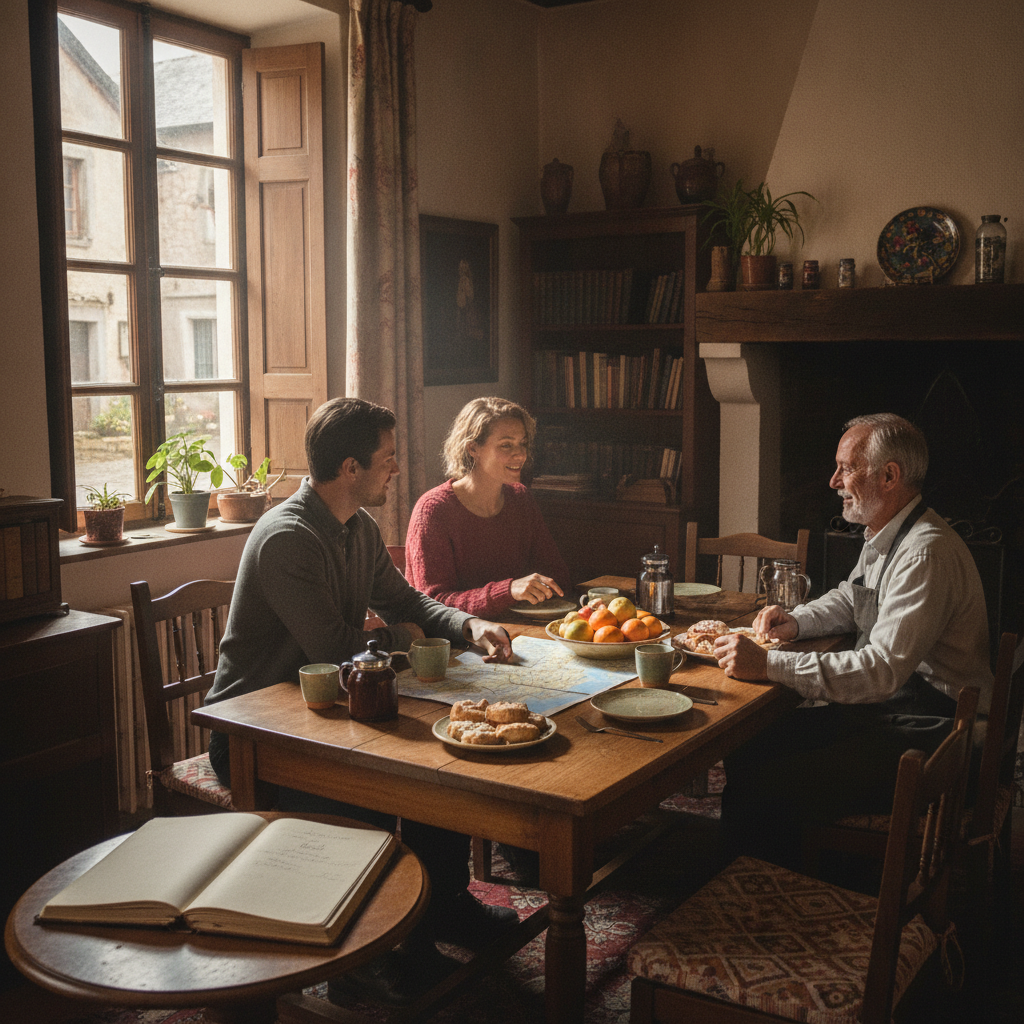
There is a particular kind of morning that only happens in certain places — the kind where the smell of someone else's cooking drifts under your door, where the person who hands you coffee also knows which back road leads to the market before the tour buses arrive. It doesn't happen at a Marriott or a Hilton. It happens in the kind of guesthouse that belongs to a place rather than merely occupying it. The choice between a chain hotel and a locally owned guesthouse is rarely framed as a meaningful one, but its consequences reach into almost every dimension of how a trip actually feels.
The Architecture of a Different Experience
Chain hotels are engineered for consistency. A traveler checking into a Holiday Inn Express in Denver or one in Lisbon will encounter the same lobby logic, the same pillow menu logic, the same breakfast layout. That predictability has real value — it removes friction for business travelers and families on tight schedules. But it also removes the texture that tends to become the most vivid part of a memory. A locally owned guesthouse in Oaxaca, or a family-run pensione in a Venetian neighborhood like Cannaregio, operates on an entirely different principle: the space reflects the people who built it, the objects in it have provenance, and nothing has been standardized into neutrality. Travelers who have spent a week in each type of property almost universally report that the guesthouse left the stronger impression — not because of amenities, but because of specificity.
What Proximity to Local Knowledge Actually Means
The phrase "local knowledge" gets used loosely in travel writing, but in the context of a guesthouse stay, it points to something concrete. The owner or host of a small property tends to be a resident of the neighborhood, not a shift manager rotating between properties. When a guest at a riad in Marrakech's medina quarter asks where to eat, the answer they receive is filtered through genuine preference and community relationship rather than a hotel concierge referral system tied to commissions. This distinction matters more than it might initially seem. Recommendations carry real weight when they come from someone with skin in the game — someone whose reputation in the neighborhood is bound up in whether their guests have a good experience. The result is that guesthouse travelers often access a more layered version of a destination, one where the *tasca* (a small, informal Portuguese tavern) around the corner gets mentioned before the restaurant that paid for placement in a city guide.
The Economics of Choosing Locally
Staying in a locally owned property doesn't automatically mean spending less, but the money moves differently — and for travelers who care where their spending lands, that difference is substantial. When a guest pays for a night at a chain hotel, a significant portion of that revenue exits the local economy almost immediately, flowing toward corporate overhead, global reservation platforms, and international shareholders. At a family guesthouse in a place like Hoi An or Tbilisi, the same payment stays closer to where the stay actually happened. It pays the host's mortgage, buys supplies from the neighborhood market, supports the small laundry service down the street. Economists who study tourism use the term *leakage* to describe how much of a traveler's spending fails to benefit the destination community — and the leakage rate at internationally branded hotels is consistently higher than at independently owned accommodations. For the traveler, this isn't just an ethical consideration; it tends to produce a warmer, more invested host relationship, which shapes the stay in practical ways.
Discomfort as a Feature, Not a Flaw
It would be dishonest to frame locally owned guesthouses as universally superior in terms of comfort. A boutique property in Porto's Bonfim district might have thinner walls, a shared breakfast table, or a bathroom that required a renovation fifteen years ago and is overdue for another. These are real differences from the climate-controlled uniformity of a chain property. But many experienced travelers have come to regard a certain degree of functional imperfection as part of what makes a stay memorable rather than interchangeable. The shared breakfast table forces conversation. The thinner walls carry the sounds of the street at dawn. The aging bathroom has a window that opens onto a courtyard with a fig tree. None of this appears in a star rating, and none of it can be replicated by a property that has optimized primarily for review scores. The traveler who can hold both the inconvenience and the character at once tends to get significantly more out of the experience.
What Changes When You Come Back
There is one effect of guesthouse travel that takes slightly longer to notice: the way it changes how a traveler thinks about returning. Guests who stay at chain hotels tend to think of destinations in terms of attractions — what they saw, what they ate, what the weather was like. Guests who stay at a locally owned property often develop something closer to a relationship with the place itself, mediated through the relationship with the host. It is not unusual for someone who stayed at a small guesthouse in Chiang Mai or Ljubljana to find themselves exchanging occasional messages with the host years later, or to book the same room on a return visit specifically because of that continuity. The property becomes a point of orientation rather than just a bed. For travelers who return to places they love — and many do — this sense of ongoing connection is one of the more durable rewards a trip can produce.
The morning that begins with borrowed coffee and unsolicited directions is easy to overlook when you're booking. It rarely appears in the promotional photography, and no algorithm ranks it as an amenity. But when you trace back the moments from a trip that still surface unprompted years later — the conversation, the shortcut, the sense of having been somewhere real — they tend to originate in exactly that kind of morning. The choice of where to sleep is also, quietly, a choice about what kind of traveler you want to be and what kind of trip you want to remember.