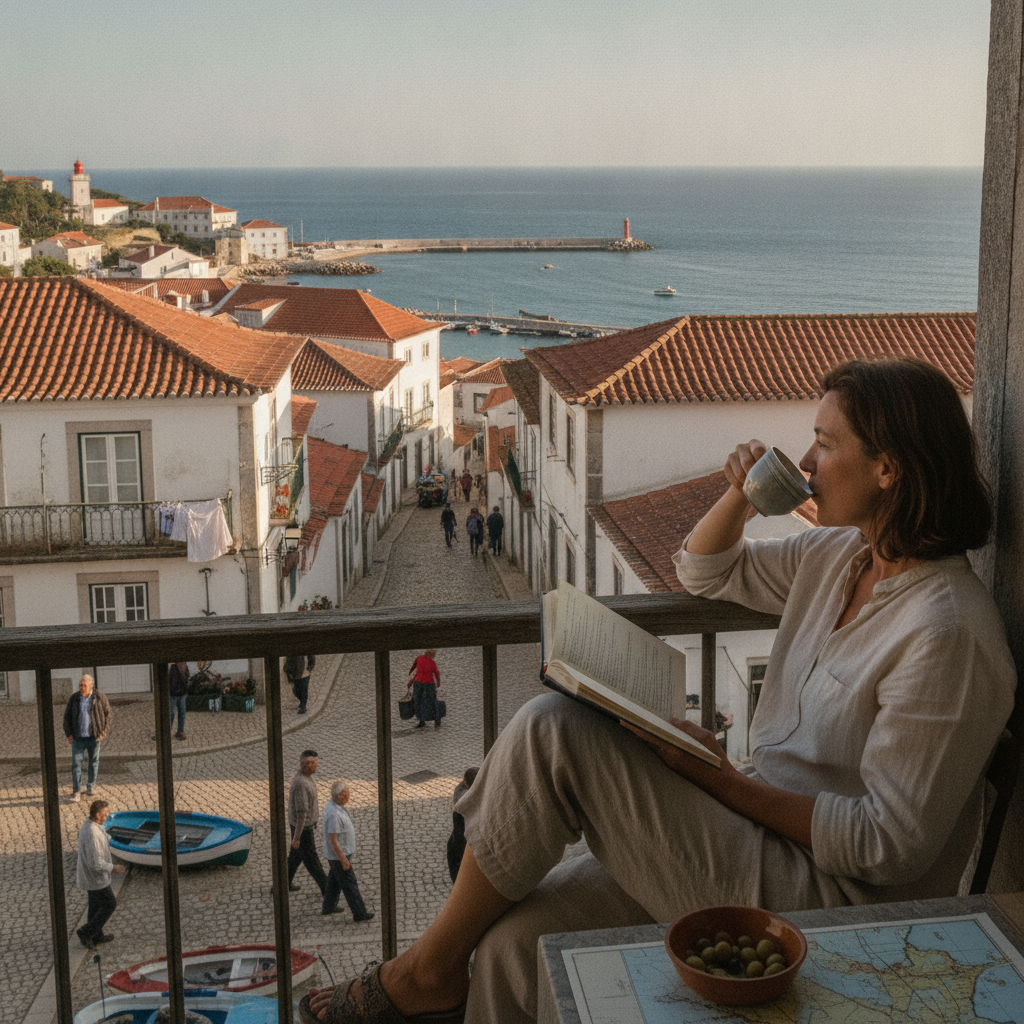
There is a particular kind of exhaustion that arrives not from too much walking, but from too much moving. Travelers who have spent two weeks hopping between five countries — luggage wheeled across six train stations, currencies exchanged and forgotten, cities ticked off like obligations — often return home with photographs that outnumber their actual memories. The trip was full, technically. It was also, in some important sense, empty. The antithesis of that experience is what slow travel practitioners quietly call *séjour prolongé* — the extended stay — and the lessons it teaches about value, cost, and connection are difficult to arrive at any other way.
What the First Week Actually Costs You
The first week of any extended stay in a single country is, in many ways, a tax. A traveler settling into Lisbon's Mouraria neighborhood or a modest apartment in Chiang Mai's Nimmanhaemin district spends that initial stretch absorbing friction: learning which market has the freshest produce, which bus route makes sense, which coffee shop has reliable Wi-Fi and which just claims to. These are not romantic discoveries — they are logistical groundwork, and they cost time, small missteps, and occasionally money. But unlike the traveler on a five-country itinerary, who never gets past this phase in any location, the month-long visitor eventually moves through it. By day ten, the friction is mostly gone. By day fourteen, something resembling ordinary life begins to form — and that is precisely where the real value of the trip begins to reveal itself.
The shift is economic as well as experiential. Once a traveler knows which neighborhood bakery sells yesterday's bread at a discount, or that the local bus costs a fraction of the tourist shuttle, the daily spend drops considerably without any sacrifice in comfort. The financial benefits of slow travel are not automatic — they require that initial learning period — but they become substantial once the local rhythm is understood. Booking a single apartment for four weeks almost always costs less per night than four separate hotels, and the kitchen access alone changes the texture of daily spending in ways that are hard to appreciate until they're lived.
The Difference Between Seeing a Place and Understanding It
There is a concept in Portuguese culture called *saudade* — often translated as a melancholic longing for something beloved and perhaps lost, though the word resists clean translation. Hearing about *saudade* in a guidebook and actually hearing it in conversation, understanding why a particular fado melody stirs it in the people around you, are two profoundly different encounters with the same idea. The first is information. The second is comprehension. A month in one country creates enough accumulated exposure that the gap between those two states begins to close.
This matters for travelers who measure trip value in experiences rather than destinations. A week in Japan yields cherry blossoms and ramen and the efficient marvel of the Shinkansen. A month in Japan might yield all of that, and also a slow friendship with a neighborhood shopkeeper, an accidental invitation to a local festival in a town that appears on no itinerary, an understanding of why the concept of *ma* — negative space, deliberate pause — appears in everything from garden design to conversation. The country stops being a backdrop and starts being a context. That shift cannot be purchased with a better hotel or a more curated tour. It is only available to those who stay long enough to earn it.
How Extended Stays Reshape What You Actually Spend Money On
The spending patterns of a month-long traveler look almost nothing like those of someone passing through the same destination over three days. The brief visitor concentrates spending on the obvious: entrance fees, restaurant meals at well-reviewed establishments, guided tours, souvenir shops near the main square. These are fine pleasures, but they are expensive ones, and they occur entirely within the tourist economy — a parallel financial world that exists alongside the local one without ever quite touching it.
The extended traveler, by contrast, gradually migrates out of that parallel economy. Groceries replace restaurant meals some evenings. A monthly transit pass replaces single-fare tickets. The neighborhood laundromat, the pharmacy, the hardware store where a broken bag strap gets repaired for almost nothing — these become part of the budget in ways that feel ordinary rather than adventurous, and they are almost always cheaper than their tourist-facing equivalents. Apps like Wise for currency management and Google Maps in offline mode become daily tools rather than emergency resources. The overall daily cost tends to fall, sometimes significantly, while the quality of experience — measured by depth rather than variety — rises in proportion.
What You Learn to Measure Differently
Brief travel teaches you to measure value in highlights. Extended travel teaches you to measure it in texture. After a month in one country, the things a traveler remembers most vividly are rarely the famous landmarks — those were visited early, often with everyone else, and documented thoroughly. What lingers is the specific quality of afternoon light in a particular town square, the way a week of rain changed the color of the hills, the gradual understanding of why people eat dinner at a certain hour and what that says about how they structure their days. These are not the things that photograph well or translate easily into travel captions. They are the residue of genuine presence, and they carry a different kind of weight.
For travelers who worry that spending a month in one country means missing everything else, the counterargument is simple: most of what gets missed in a fast itinerary was never truly experienced to begin with. Ticking a city off a list and knowing a city are different activities. One produces a record of having been somewhere. The other produces an understanding of what it is like to be somewhere — and that understanding, however incomplete after only a month, is the closer approximation of what travel at its most rewarding is actually for.
The traveler who once wheeled luggage through six countries in two weeks, accumulating stamps and photographs and that particular exhaustion that has nothing to do with walking, often finds that a single month spent unhurriedly in one place reorganizes everything they thought they knew about what a trip was supposed to deliver. The pace changes. The spending changes. And the memories — slower to form, more fully earned — turn out to be the ones that actually stay.