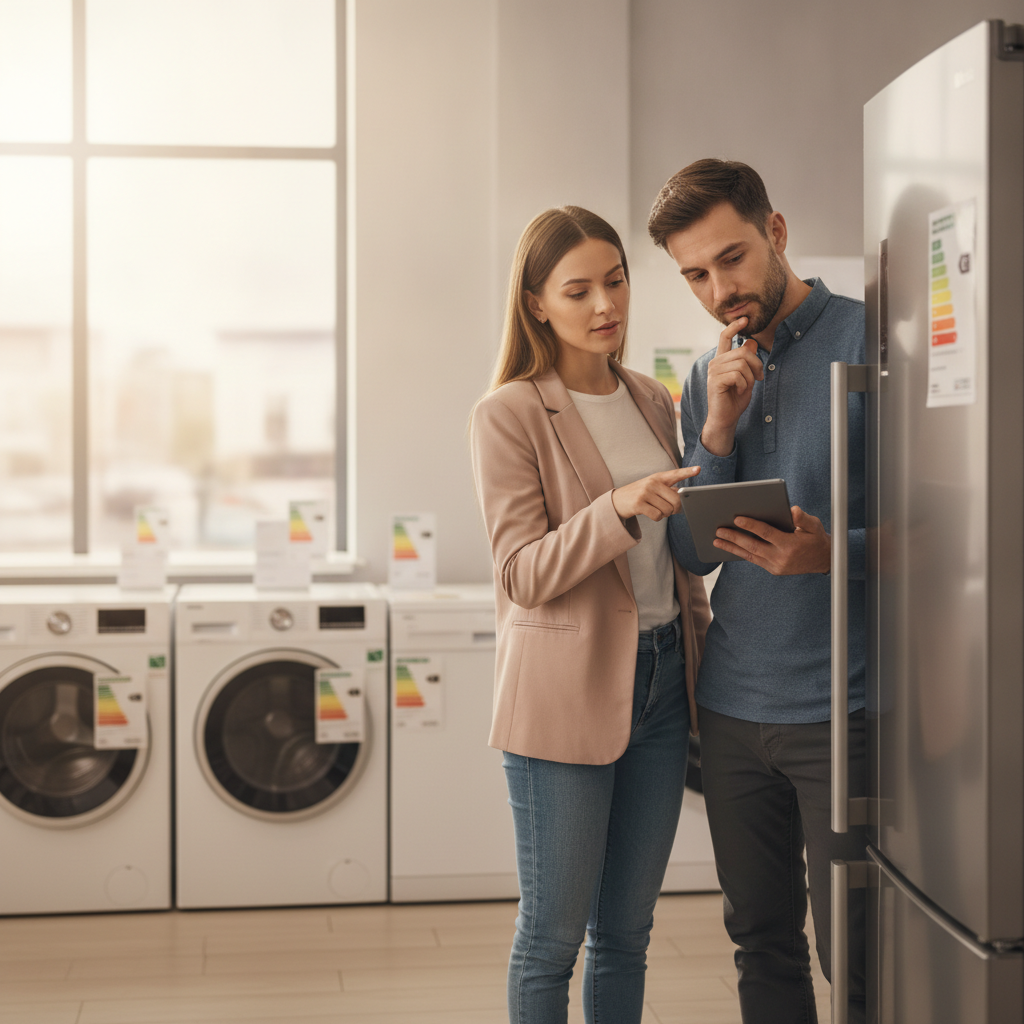
Buying a new appliance feels straightforward until the electricity bills start rolling in and you realize the sticker price was only part of the story. Energy ratings exist precisely to close that gap — to give shoppers a reliable way to compare what appliances will actually cost to run over months and years. The problem is that most people glance at a label, see a letter or a star, and move on without understanding what that rating is really telling them. Learning to read these labels properly changes the whole calculation.
What the EnergyGuide Label Is Actually Telling You
The yellow EnergyGuide label found on most major appliances in the United States is required by the Federal Trade Commission and is one of the most useful tools a shopper has. It displays an estimated annual energy cost based on average usage and a standard electricity rate, along with a scale showing how that model compares to similar products on the market. The cost estimate won't match your bill exactly — your local utility rates and actual usage patterns will differ — but it gives you a reliable comparison baseline. The key is to use it relationally, not absolutely.
Understanding Energy Star Certification and What It Requires
Energy Star is a certification program run by the U.S. Environmental Protection Agency, and it sets minimum efficiency thresholds that products must meet to earn the label. Not all Energy Star appliances are equal, though. A refrigerator that barely clears the certification threshold and one that exceeds it by a wide margin both carry the same logo, so it pays to look beyond the badge. The EnergyGuide label will reveal the difference, and within a product category, comparing annual energy estimates between certified models tells you far more than the certification alone.
How to Compare Annual Energy Cost Estimates Across Models
The annual energy cost estimate printed on the EnergyGuide label assumes a specific electricity rate — usually a national average — which may be higher or lower than what you actually pay. To get a more accurate picture, find your rate on your electricity bill (measured in cents per kilowatt-hour) and adjust proportionally. If your rate is meaningfully higher than the label assumes, the gap between an efficient model and a less efficient one widens further. Brands like LG, Bosch, and Whirlpool often publish detailed spec sheets with exact kilowatt-hour consumption figures, which makes this kind of calculation straightforward.
The Real Cost Lives in the Lifetime Running Total
A less efficient appliance might carry a lower purchase price, but that gap often reverses over the product's lifespan. A refrigerator runs continuously for ten to fifteen years, and even a modest difference in annual energy consumption compounds significantly over that time. When comparing two models, a useful exercise is to multiply the annual energy cost difference by the expected lifespan of the appliance. That number — not the purchase price difference — is the true financial comparison you should be making before you hand over your credit card.
Size and Capacity Ratings Affect Efficiency More Than You'd Think
Appliances are rated against others of similar size and capacity, which means a compact dishwasher and a full-size dishwasher can both earn Energy Star certification while using very different amounts of energy. Buying more capacity than you routinely need works against efficiency in two ways: the appliance consumes more energy per cycle, and it may encourage less-than-full loads that waste both water and electricity. Matching the appliance size to your actual household needs — rather than defaulting to the largest available model — often delivers better real-world efficiency than chasing a higher rating on an oversized unit.
Washer and Dryer Ratings Deserve Special Attention
Clothing washers and dryers are among the highest energy consumers in a typical home, and their ratings involve more variables than most other appliances. Washer efficiency ratings factor in water consumption as well as electricity, and the Modified Energy Factor (MEF) printed on some labels captures both. Dryers present a newer opportunity: heat pump dryers, now offered by brands like Miele and Samsung, use dramatically less energy than conventional electric models, and while their upfront cost is higher, their running cost advantages are significant over a standard product lifespan. Checking for both energy and water efficiency ratings together gives the clearest picture.
How Smart Features and Modes Interact with Energy Ratings
Many modern appliances include eco modes, delay-start features, or demand-response capabilities that allow them to run during off-peak electricity hours. These features aren't always reflected in standard energy ratings, which are typically based on default settings. An appliance with a strong base rating that also supports smart scheduling can outperform its label in real-world conditions. When evaluating smart appliances, it's worth reading the manufacturer's specifications on exactly how much energy a particular mode reduces — some eco settings produce meaningful savings while others offer only marginal differences.
Reading the Label on HVAC and Water Heating Equipment
Heating, cooling, and water heating systems use their own rating scales that differ from appliance labels. Air conditioners are rated by SEER2 (Seasonal Energy Efficiency Ratio), heat pumps by HSPF2, and water heaters by Uniform Energy Factor (UEF). Higher numbers mean better efficiency across all three. These systems represent the largest share of home energy use, so even a moderate improvement in rating translates to more noticeable savings than equivalent gains in smaller appliances. When replacing HVAC equipment or a water heater, taking time to compare efficiency ratings across models from manufacturers like Carrier, Rheem, or Trane directly shapes your utility costs for the next decade or more.
Energy rating systems are continuing to evolve, with updated testing standards being rolled out regularly to better reflect real-world usage patterns rather than idealized lab conditions. The shift toward electrification in homes — more heat pumps, electric ranges, and EV chargers drawing from the same service panel — makes understanding appliance efficiency more consequential than it has ever been. Shoppers who get comfortable reading these labels now will be well-positioned to make decisions that hold up financially as energy costs and home technology continue to change.